2450 mi to ft
2450 Miles to Feet
2450 Mile to Foot converter
The measurement of 2,450 miles, which converts to approximately 12,936,000 feet, represents a significant distance that can be applied in various contexts such as travel, geography, and infrastructure. Understanding this distance in both miles and feet is essential for numerous fields, including aviation, automotive travel, and long-distance hiking, among others. When considering 2,450 miles, it can be helpful to illustrate its scale within familiar parameters. For instance, it is roughly equivalent to the distance between several major cities; for example, it spans the distance between Los Angeles, California, and New York City, or can be comparable to the width of the continental United States. With this vast distance in mind, one can ponder how long it would take to traverse this length via different transportation means. Traveling by car at an average speed of 60 miles per hour will require around 40.8 hours of continuous driving, not accounting for necessary breaks or overnight stays. By contrast, a commercial flight typically covers this distance much more rapidly, reducing the travel time to a matter of hours.In geographical terms, 2,450 miles is also significant when discussing the circumference of the Earth. The planet’s circumference is about 24,901 miles, meaning that 2,450 miles represents approximately 9.8% of the entire earth's circumference, which gives a sense of its relative scale on a global level. Such measurements can be crucial for environmental studies, global positioning, and in understanding the Earth's geography in relation to various ecosystems.Additionally, for those involved in the sporting world, especially in ultra-distance events or marathons, 2,450 miles represents extreme endurance challenges. The concept of long-distance running can draw parallels to this distance, with athletes training rigorously to cover extensive mileage over set periods of time. In infrastructure and logistics, understanding distances in both miles and feet is critical for planning transportation routes, implementing supply chain strategies, and optimizing delivery schedules. When calibrating maps or analyzing travel routes, professionals must ensure that distances are accurately represented to facilitate navigation and planning.In the realm of data and technology, this distance can also be translated into various metrics that aid in the development of applications and services geared toward mapping, navigation, and geographic information systems (GIS). The conversion between miles and feet is essential for engineers, architects, and urban planners who require precision in their designs and projects.Overall, the measurement of 2,450 miles (or 12,936,000 feet) holds substantial relevance across various sectors, from travel and transportation to research and infrastructure development. A solid understanding of this distance can enable better planning, enhance logistics operations, and provide a contextual framework for comprehending geographic and environmental dimensions. As such, whether you are studying geography, planning a long-distance trip, or analyzing Earth's features, recognizing the significance of these measurements is essential for both practical applications and theoretical discussions.
How to convert 2450 Miles to Foot?
| 2450 mi * | 5280 ft | = 12936000 ft |
| 1 mi |
A common question is How many in 2450 ? And the answer is 0.464015 mi in 2450 ft. Likewise the question how many in 2450 has the answer of 12936000 ft in 2450 mi.
How much are 2450 Miles in Feet?
2450 Miles equal 12936000 Feet (2450 mi = 12936000 ft). Converting 2450 mi to ft is easy. Simply use our calculator above, or apply the formula to change the length 2450 mi to ft.
Convert 2450 mi to common Lengths
| Unit | Length |
|---|---|
| Nanometer | 3942892800000000 nm |
| Micrometer | 3942892800000.0005 µm |
| Millimeter | 3942892800 mm |
| Centimeter | 394289280 cm |
| Inch | 155232000 in |
| Foot | 12936000 ft |
| Yard | 4312000 yd |
| Meter | 3942892.8 m |
| Kilometer | 3942.8928 km |
| Nautical Mile | 2128.991793 nmi |
What is 2450 Miles in ft?
To convert 2450 mi to ft multiply the Lengths in by 5280. The 2450 mi in ft formula is [ft] = 2450 * 5280. Thus, for 2450 Miles in Foot we get 12936000 ft.
2450 Mile Conversion Table
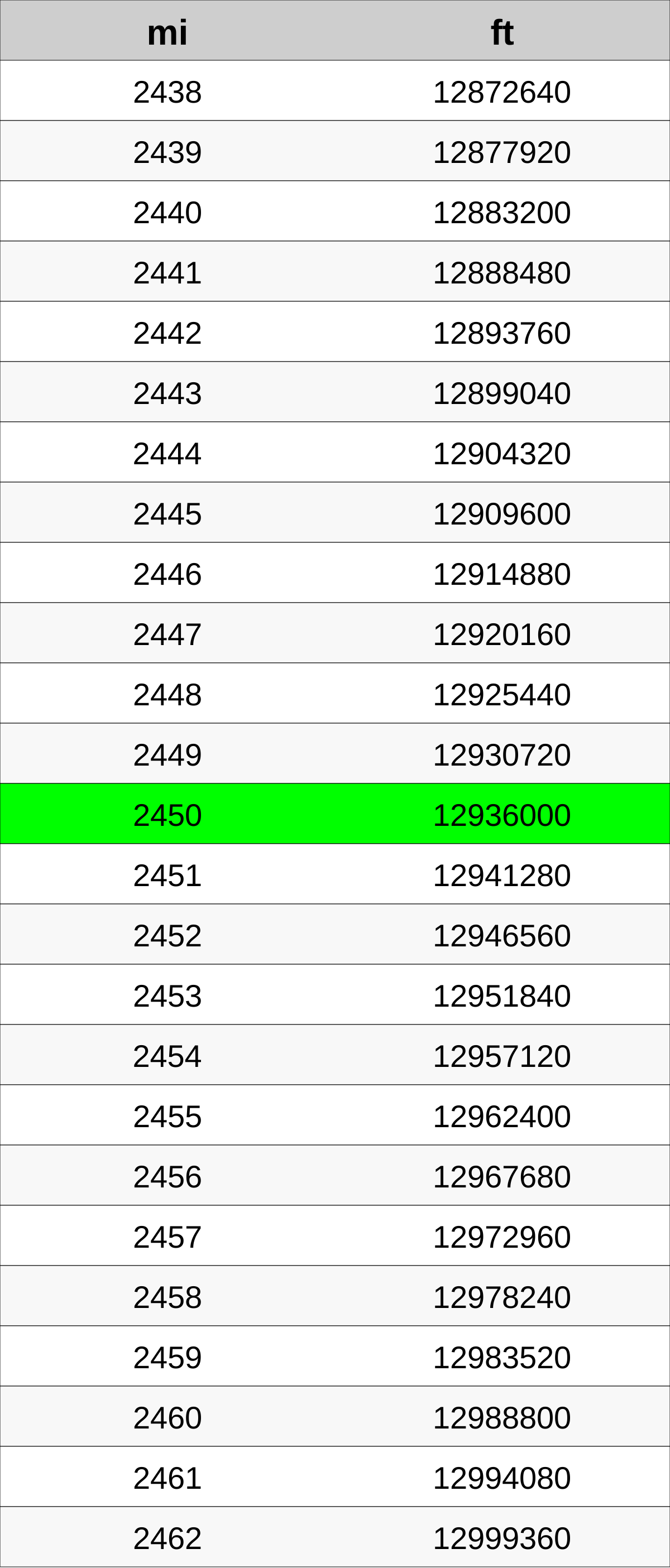
Further Mile to Foot calculations
- 2350 mi to ft
- 2360 mi to ft
- 2370 Miles to Feet
- 2380 mi to ft
- 2390 mi to ft
- 2400 mi to Foot
- 2410 mi to Feet
- 2420 mi to Feet
- 2430 Miles to ft
- 2440 Miles to Feet
- 2450 Miles to Feet
- 2460 mi to ft
- 2470 mi to ft
- 2480 mi to ft
- 2490 mi to Foot
- 2500 mi to Feet
- 2510 mi to ft
- 2520 mi to Feet
- 2530 Miles to ft
- 2540 Miles to Foot
- 2550 Miles to ft
Alternative spelling
2450 mi to ft, 2450 mi into ft, 2450 mi in ft, 2450 Mile to Foot, 2450 Mile into Foot, 2450 Mile in Foot, 2450 Miles to Feet, 2450 Miles into Feet, 2450 Miles in Feet, 2450 Mile to ft, 2450 Mile into ft, 2450 Mile in ft, 2450 mi to Foot, 2450 mi into Foot, 2450 mi in Foot, 2450 Miles to ft, 2450 Miles into ft, 2450 Miles in ft, 2450 mi to Feet, 2450 mi into Feet, 2450 mi in Feet
Further Languages
- 2450 Miles To Feet
- 2450 миля в крак
- 2450 Míle Na Stopa
- 2450 Nil Til Fod
- 2450 Meile In Fuß
- 2450 μίλι σε πόδι
- 2450 Milla En Pie
- 2450 Miil Et Jalg
- 2450 Maili Jalka
- 2450 Mille En Pied
- 2450 Milja U Stopa
- 2450 Mérföld Láb
- 2450 Miglio In Piede
- 2450 Mylia Iki Pėda
- 2450 Mil Fil Piedi
- 2450 Mijl Naar Voet
- 2450 Mila Na Stopa
- 2450 Milha Em Pé
- 2450 Milă în Picior
- 2450 Míľa Na Stopa
- 2450 Engelsk mil Till Fot
- 2450 Myl In Voet
- 2450 قدم إلى ميل
- 2450 Mil Ayaq
- 2450 মাইল মধ্যে ফুট
- 2450 Milla A Pe
- 2450 मील से पैर
- 2450 mil Ke Kaki
- 2450 マイルズトゥフィート
- 2450 마일 발
- 2450 Engelsk mil Til Fot
- 2450 миля в нога
- 2450 Mile V Čevelj
- 2450 Milje Në Këmbë
- 2450 ไมล์ไปที่เท้า
- 2450 માઇલ પગ
- 2450 Mil Fit
- 2450 миля в нога
- 2450 Dặm Anh Sang Foot
- 2450 英里为英尺
- 2450 英里至英尺